Why I started Salad Recipes Fresh
It started with a salad. Not even a good one—just a wilted mess of lettuce and dressing that my roommate ate while complaining about how ‘amateur’ it was. I’d followed a recipe from a cookbook, but something was off: the greens were limp, the flavors flat.
That night, I realized most recipes treat salads like an afterthought. They’re either too rigid or too vague, and no one explains *why* a dressing should rest or how to pick a tomato that won’t turn to mush in your bowl.
So I began writing down what actually worked in my own kitchen—notes scribbled on napkins, timelines for wilting, the exact ratios that made a vinaigrette sing. This site is for anyone who’s ever stared at a sad salad and wondered, *‘What if I did it differently?’* No pretension, no perfectionism.
Just recipes that taste like they were made with intention, not luck.
Meet the founder

My abuela used to say, *‘A salad is just a story waiting to happen.’* She’d chop cilantro with one hand and lecture me about ‘respecting the knife’ with the other.
The first time I tried to make her *ensalada de naranja con jicama*, I overcooked the shrimp and drowned the citrus in oil. She didn’t yell—just handed me a lemon and said, *‘Start again.
But this time, taste the dressing before you pour.’* That’s the method I still use: taste, adjust, repeat.
The only kitchen tool I’ve ever owned that wasn’t a hand-me-down is a 1970s cast-iron salad spinner with a cracked handle. It’s held together by duct tape and stubbornness.
I keep it because it’s the only one that actually spins—unlike the flimsy plastic ones that collapse under a handful of greens. (And yes, I’ve tried every ‘best’ spinner on the market. They’re all overrated.)
The failure that changed everything was a charred batch of grilled peaches for a summer salad. I’d rushed them over the flame, and they turned to ash before they caramelized. That’s when I learned to watch the smoke *and* the color—peaches should blister, not burn.
Now, I time everything by the sound: a good sear has a voice, like a sizzle turning into a whisper.
I have a habit of tasting raw ingredients before I cook them. Almonds? Crunchy enough. Avocado? Ripe but not mushy.
It drives my partner crazy, but I can’t help it—I need to know if the base is already winning or doomed. (Spoiler: If the tomato tastes like nothing, the salad’s going to be boring.)
Meet the mascot

The mascot started as a doodle on a grocery-store receipt, scribbled during a 10-minute wait in the produce aisle.
I’d meant to sketch a simple carrot, but the first line I drew was too long, and the second too short—so I turned it into a rabbit mid-hop, ears flopping over a bowl of greens.
The ‘salad’ part was just a smudge, but I liked that it looked like something you’d grab in a hurry.
The proper drawn version came later, after I’d scanned the receipt and traced it in ink. I added a chef’s hat (because why not?) and a splatter of dressing on the nose—part accident, part rebellion against ‘perfect’ food art.
The rabbit’s paws ended up too small, so I redrew them three times, each time making them clumsier, like it’s just learned to hold a fork.
For the final version, I had to simplify everything except the bowl.
The ears had to go (they looked like antennae), the hat became a single line, and the dressing splatter turned into a single dot—because at the size of a browser tab, you only need one thing to recognize it.
I named it *Pepín*, after the tiny green peppers my abuela used to scold me for stealing from her garden.
What I promise you
You’ll never see a recipe here that doesn’t work as written—or at least, one that doesn’t tell you *exactly* where it might fail. If I say ‘rest the dressing for 10 minutes,’ it’s because I’ve seen what happens when you skip it: a salad that tastes like vinegar and regret.
What you can hold me to
- Every ingredient is measured in grams or cups—no ‘handfuls’ unless I’ve tested what a handful actually weighs.
- If a step feels vague (like ‘until it looks right’), there’s a backup method in the notes.
- The ‘serves’ number is accurate for normal portions. If you’re feeding a crowd, the math is in the fine print.
- I’ll admit when I don’t know. If a recipe is untested or borrowed, I’ll say so—and where to find the original.
How I create a recipe
A recipe here always starts with a question, not a cookbook.
Maybe it’s *‘How do I make a salad that doesn’t wilt in 30 minutes?’* or *‘What’s the secret to a dressing that doesn’t curdle?’* I answer it by cooking the same dish three times, each time changing one thing—the oil ratio, the chop size, the resting time—and tasting it blind.
The third try is usually the one that sticks.
The first cut: prep like a pro
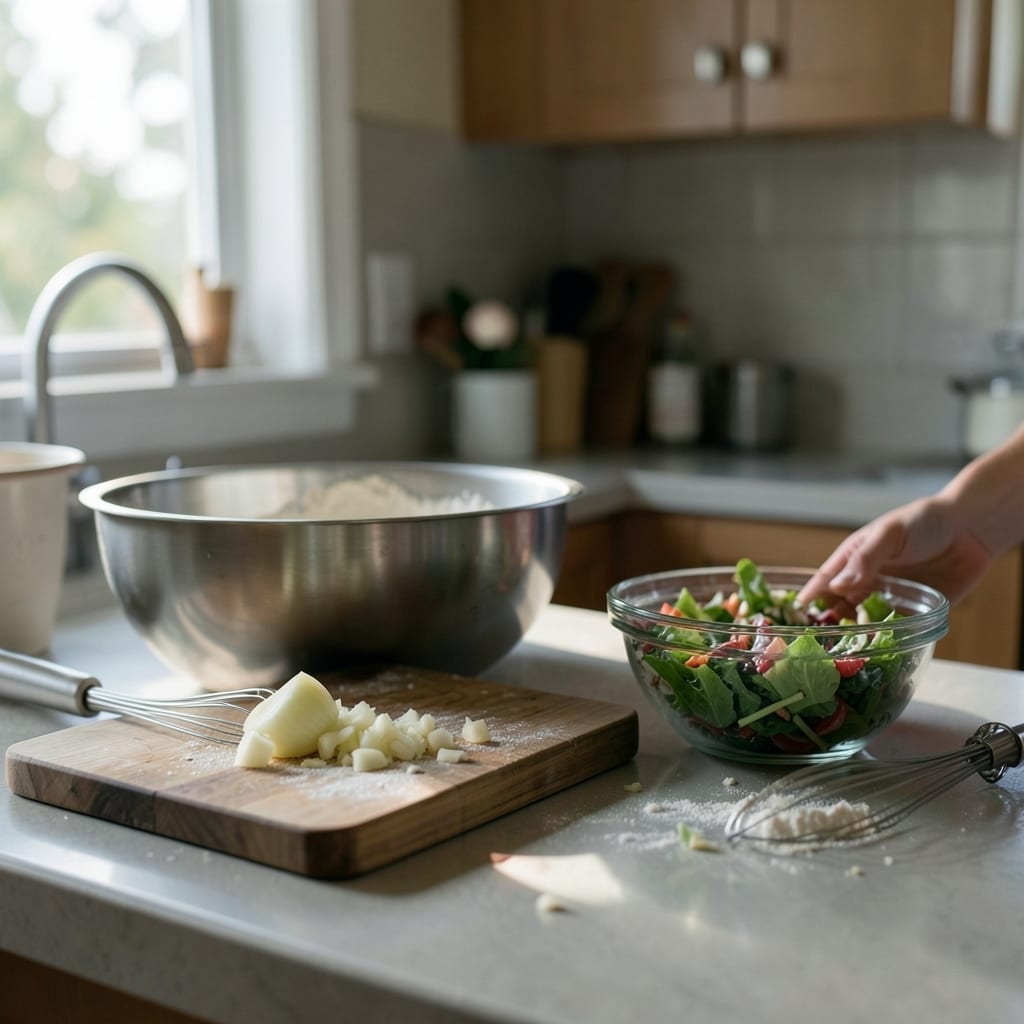
The first step is always the knife work, and I never start until the veggies are ice-cold from the fridge. A sharp chef’s knife (I use a German steel) and a cutting board that’s been dampened to keep things from sliding—because nothing ruins a salad faster than a sliced thumb.
I chop everything to the same size: a ½-inch dice for crunch, a julienne for texture. If the carrots are still hard after 30 seconds of cutting, I switch to a mandoline.
The moment it goes wrong is when the knife starts slipping. That’s when I know the board’s dry or the knife’s dull. I stop, wipe the board with a damp towel, and hone the blade on a leather strop. A good cut should sound like a whisper, not a scream.
If the celery snaps instead of slicing cleanly? That’s a sign to start over—or at least, to accept that the salad’s going to be less crisp than it could be.
The fix: dressing is science
Dressings are made in a small bowl with a whisk, never a shaker bottle. I measure the oil first (always the *last* ingredient in the recipe, so it doesn’t separate), then the acid (lemon juice, vinegar), and finally the sweetener (honey, sugar).
I whisk for exactly 30 seconds, then let it sit for 10 minutes—this is non-negotiable. The emulsion breaks if you rush it, and no one wants a salad that looks like oil and water fought and lost.
If it still separates, I add a teaspoon of Dijon mustard or a splash of warm water and whisk again. The fix is always the same: patience. A good dressing should coat the back of a spoon like a thin film, not pool at the bottom.
If it does, I taste it raw—because sometimes, the problem isn’t the technique, but the ingredients. (Store-bought balsamic? That’s why your vinaigrette tastes like syrup.)
How a page gets onto this site
While the salad’s still warm, I jot down everything: the exact time it took to chop, how long the dressing rested, and what I’d do differently next time. Then I let it sit overnight.
The second draft is always shorter—I cut the ‘fluff’ and keep only the steps that actually matter.
If a recipe gets rewritten months later, it’s because someone wrote to say it didn’t work, or because I finally figured out why the tomatoes always turned to mush. (Answer: They were picked too early.)
Write to me
I love hearing about the salads you’ve ruined—and the ones you’ve saved.
Send me your disasters (and your triumphs) or ask me anything: *‘Why does my goat cheese always clump?’* or *‘How do I make a salad that doesn’t taste like the office cafeteria?’* The contact page is the place to do it.
And if you’re feeling bold, tell me what you’d add to the menu here.
Thanks for letting me share the stories behind the bowls.
—Marisol Novak
The recipes are grouped by category: Appetizers, Beverages, Breakfast & Brunch, Desserts, Main Courses and Reviews.